

Atlas is a visual research workspace for people who need to understand a body of papers. That work might be a thesis, a treatment decision, a buying brief, or a literature review. Mem is an AI-first note app. It can auto-tag notes, answer questions over your notes with Ask Mem, and capture ideas from mobile or email. The best second-brain apps guide places that workflow in its broader category.
AtlasBuild a cited Knowledge Map from your sources
Upload research papers and connect each answer to its supporting passage.

Quick answer
The split appears after the first answer. Atlas turns each paper into a Knowledge Map, which is a visual map of the paper's argument. It turns one project into a Semantic Map. Atlas also runs answers through claim-source-justification, so each claim points to a source passage and explains why that passage supports it. Sources, notes, maps, and chats remain scoped to that project.
Mem is strong at personal capture. Its auto-tags, Ask Mem chat, and mobile flow are useful when your notes are the source of truth. The best note-taking apps guide compares that category. Atlas earns the comparison when the answer must be trusted, checked, and reused.
Mem is built for fast notes and AI recall. Atlas is built for source-backed research projects and runs as a managed cloud workspace. If you are testing self-hosted agent memory systems, Mem0-like tools are the closer match. If you need to trace an answer to a paper paragraph, Atlas is the relevant comparison.
Criteria and methodology
We compared the tools by the research task each user needs to finish. Atlas was scored on source upload, paper maps, cited answers, project maps, and reuse across a research corpus.
Mem was scored on note capture, auto-organization, Ask Mem recall, mobile capture, and personal-note workflow. The key question is whether the task starts from sources that need citations or from personal notes that need easy recall.
Feature comparison matrix
| Atlas | Mem |
|---|---|
| Citation grounding: claim, source passage, and justification shown together. Atlas wins for defensible research synthesis. | Ask Mem searches notes. Claim-level justification is outside its core surface. |
| Knowledge Maps: deconstructs uploaded papers into claims, evidence, definitions, and relations. Atlas wins for research recall. | Auto-organizes personal notes and tags. Mem wins for low-friction capture. |
| Source upload: built around papers, markdown, and project sources that need cited answers. | Built around mems, daily notes, meetings, and personal capture. |
| Project context: sources, notes, Knowledge Maps, Semantic Maps, and chats share one project-scoped evidence base. | Per-account note graph helps personal recall. |
| Low-friction personal capture: ✗ Atlas asks you to choose a project first. | Mem ✓ auto-tags notes and keeps capture lighter. |
| Pricing: evaluation sample, then Atlas Pro at $20/mo or $204/yr. | Mem is lower-cost for personal notes at $10/mo or $99/yr. |
Table 1: The table is the proof surface for the comparison. Atlas is stronger when the output must cite sources. Mem is stronger when personal capture and recall are the main tasks.
Interface snapshots
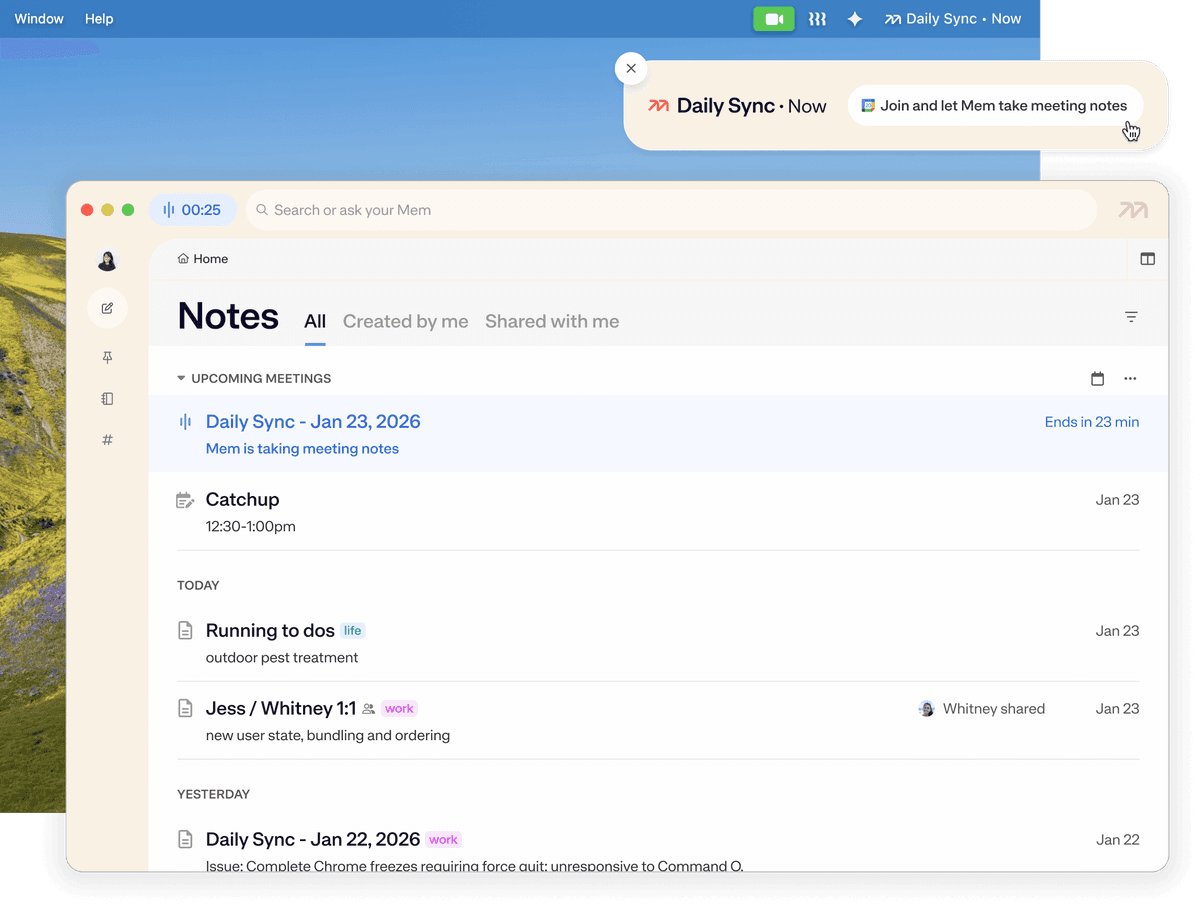
This official Mem screenshot shows Daily Sync taking meeting notes inside the personal notes interface. It supports the capture-and-recall workflow described in the comparison.
How is Atlas different?
Atlas and Mem overlap on reading, notes, and AI answers. They split on three jobs that decide whether the output can be checked by someone else.
Visual maps for papers and projects
Atlas builds two visual maps as you read. A Knowledge Map breaks a paper into claims, evidence, definitions, and links between them. You see the paper's spine first. Then you can open the supporting passage with a click.
A Semantic Map works at the project level. It places sources, notes, chats, and citations on a visual canvas. Related items cluster by topic. You can view the same project from a new angle without re-reading the folder.
The knowledge graph guide explains how this differs from a flat note collection.
"It's like an ultimate GPT. I can finally see what I've read." Kyle Lao, CEO & Co-founder of MenSC Labs
Mem does not break each paper into a claim-and-evidence map. It also does not re-map an entire project by topic angle. If you have tried to recover a paper's structure weeks later, the Knowledge Map is the first Atlas surface that helps. Visual maps make a body of papers legible at a glance.
Source traces for every claim
Made-up text is one risk. Another is a real citation attached to an unsupported claim. Atlas answers with a claim-source-justification triple that includes the claim, source passage, and a short reason. You can open the source paragraph and read the highlighted text.
Atlas measures this with the H/V ratio. It checks how often a cited sentence fails a passage-level review. Atlas targets H/V < 0.1, and we explain the method in Verifiable AI Research (2026): What It Actually Means.
Mem answers may cite or link to sources. Mem does not make the claim-level proof trace the main surface. For casual questions, the missing trace may be acceptable. A thesis, brief, or treatment summary needs closer verification. Every claim traces to its source, and Atlas explains why the source justifies it.
Project-scoped research context
Atlas keeps sources, notes, chats, Knowledge Maps, and the Semantic Map inside the project where they were created. Those surfaces share one evidence base.
A separate Atlas project has separate sources and context. That isolation prevents unrelated evidence from entering a cited answer. Mem takes a different approach through its account-level note graph.
Comparing Atlas and Mem: features
Architecture and retrieval differences
The architecture matters because "AI memory" can mean different products. Mem is built around personal notes. It favors fast capture and recall over notes you already wrote.
Atlas is built around a research corpus. Uploaded sources become structured project objects. Citations and mentions become graph links. Answers must point back to passages that can support them.
That design is slower to explain than "ask your notes." It is also why Atlas fits literature reviews, thesis work, and research briefs. Self-hosted memory APIs and agent frameworks fall outside Atlas's scope. For those tests, Mem0-like systems are the closer comparison.
Our note-taking systems comparison explains the practical difference between capture-first and source-first organization.
Mem0, Zep, LangMem, MemPalace, and WrenAI
Mem0, Zep, and LangMem belong in a different branch of this decision. They are memory layers for AI agents and applications rather than personal note apps. Mem0 provides persistent context for agents and apps. Zep serves agent memory through context graphs. LangMem extracts useful information from interactions and maintains long-term agent memory.
MemPalace is a local-first system that stores conversation history as verbatim text for semantic retrieval. WrenAI maintains project-scoped memories for its data agent. Both belong to the agent-memory branch, while Mem remains the personal notes product in this comparison.
Use those tools when you are building an agent that needs to remember users, preferences, or prior conversations across sessions. Use Mem when you want a personal notes workspace with capture and recall. Use Atlas when the input is a research corpus and the output needs claim-level citations. Agent memory and source-grounded paper synthesis solve separate tasks.
Both tools touch a researcher's day, but they solve different jobs. Atlas covers paper maps, project maps, cited AI answers, and reuse across a research corpus. Mem covers personal notes, auto-tags, and chat over the note graph.
Mem is broader for personal note capture. Atlas is deeper when the citation has to hold up. The next sections compare paper maps, project maps, cited answers, source annotations, and long-running project memory. Each table includes at least one row where Mem wins or ties.
Paper deconstruction with Knowledge Maps
The Knowledge Map is Atlas's per-paper view. It breaks a paper into claims, evidence, definitions, and links between them. The node text comes from the paper and stays close to its wording. Breadcrumbs let you move from the main claim to a specific paragraph.
The research paper analysis guide covers the close-reading tasks behind this comparison.
| Atlas | Mem |
|---|---|
| Multi-level argument structure ✓ | Auto-tagged notes from PDF content |
| Labeled relations (motivates, causes, enables) ✓ | ✗ |
| Faithful-to-source node text ✓ | ✗ |
| Hierarchical breadcrumbs ✓ | ✗ |
| ✗ | Auto-organising notes with AI tagging ✓. Mem focuses on tagging and recall. |
Table 2: Paper deconstruction in Atlas compared with Mem note tagging.
Good to know: The bottom row belongs to Mem. Atlas does not ship that surface. The Knowledge Map's payoff is recovering a paper's argument three weeks after you first read it, when topic chips alone are no longer enough.
Project view with Semantic Maps
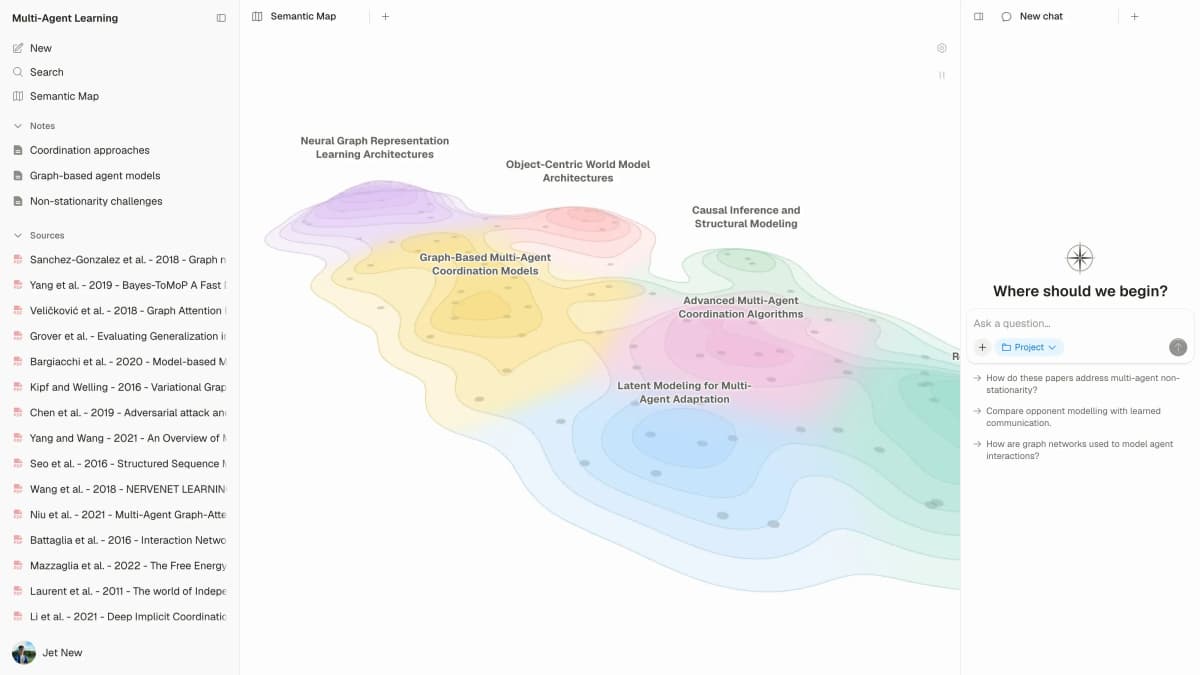
The Semantic Map is Atlas's project view. It places sources, notes, chats, and citations on a canvas. Related items cluster by topic. You can view the same project from a new angle without uploading the sources again.
| Atlas | Mem |
|---|---|
| Spatial embedding of sources + notes + chats ✓ | Auto-clustered note collections |
| Auto-labeled topic clusters ✓ | ✗ |
| Topic-angle re-projection ✓ | ✗ |
| One project-scoped evidence view ✓ | ✗ |
| ✗ | Ask Mem chat over personal notes ✓. Personal-note recall is Mem's strength. |
Table 3: Project mapping in Atlas compared with Mem note recall.
Good to know: Mem's strength on that row is genuine. If personal-note recall is the main task, Mem is the better fit. The Semantic Map helps when 200 papers become a corpus you need to inspect from several topic angles.
For the library-management side of that job, compare research paper organizers.
Citation-grounded answers
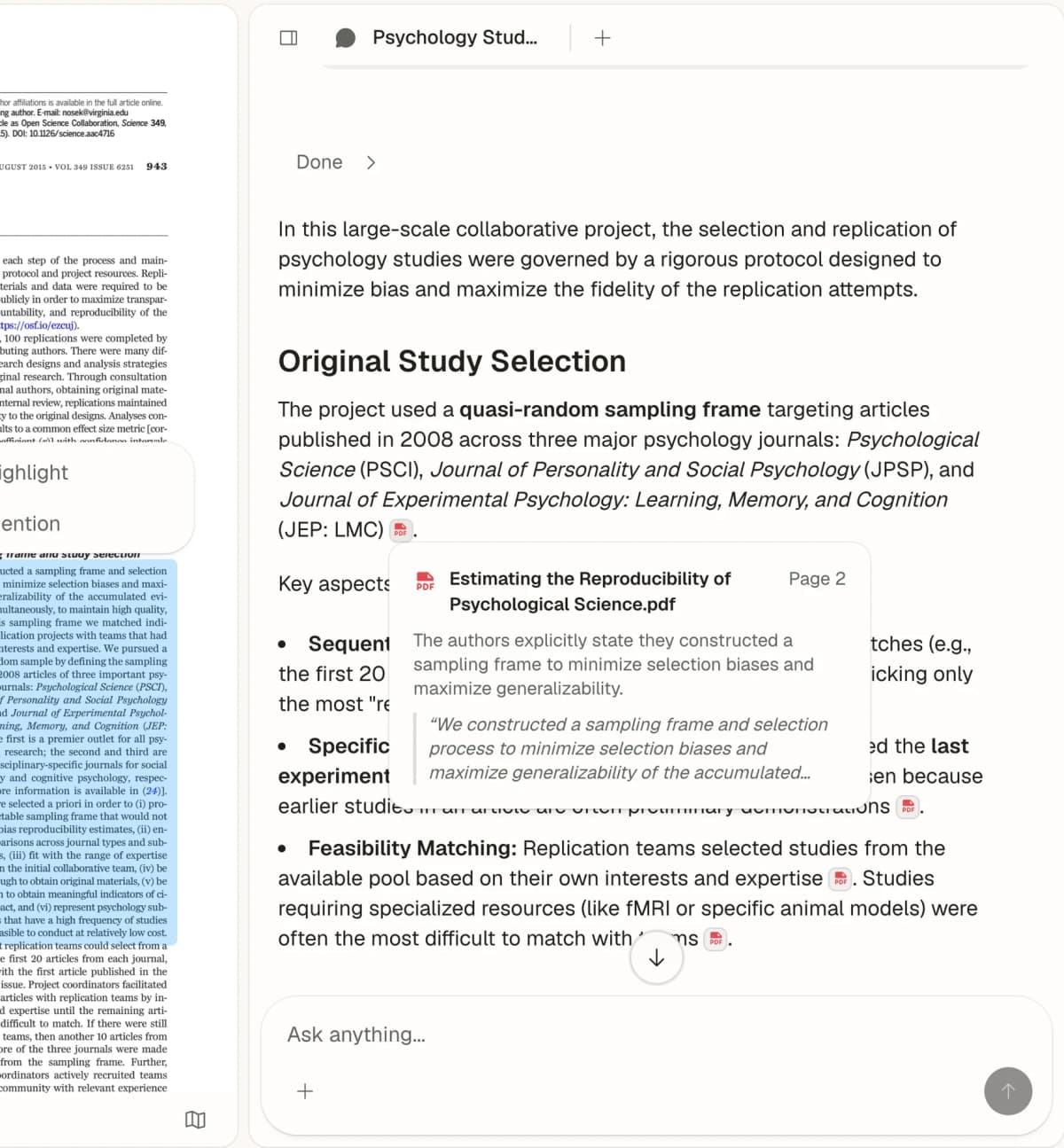
Atlas displays an answer alongside a source passage from a psychology paper. This example illustrates its cited-answer interface; it is not a comparison test against Mem. Source: Atlas Chat with Paper; embedded paper: Estimating the Reproducibility of Psychological Science.
Atlas produces claim-source-justification triples. Each answer shows the claim, the passage, and a short reason the passage supports the claim. You can jump to the source paragraph, read the highlighted sentences, and check whether the reasoning holds.
| Atlas | Mem |
|---|---|
| Claim-source-justification triples ✓ | Ask Mem AI chat (no claim-source-justification) |
| Reasoning traces (why this passage supports this claim) ✓ | ✗ |
| Jump-to-source with passage highlight ✓ | ✗ |
| H/V ratio < 0.1 benchmark published ✓ | ✗ |
| ✗ | Fast mobile capture and email-to-Mem ✓. Mem focuses on quick capture. |
Table 4: Citation evidence in Atlas compared with Mem capture tools.
Good to know: Both tools have a citation surface. Atlas also explains why a passage justifies a claim. For everyday Q&A, the extra trace may be unnecessary. It matters for a thesis sentence or brief paragraph.
The AI citation analysis guide explains how to inspect support beyond a reference link.
Literature-grounded annotations
Atlas annotates each paper when you upload it. Citations inside the paper become objects you can inspect. When the cited source is open access, Atlas can pull the relevant passage. That shows how a paper builds its argument from other sources.
| Atlas | Mem |
|---|---|
| Auto-annotate on ingest ✓ | ✗ |
| Multi-citation synthesis (how citations build the argument) ✓ | ✗ |
| Resolve cited sources (open-access) ✓ | ✗ |
| Exact passage / page / paragraph anchors ✓ | ✗ |
| ✗ | AI-driven auto-tagging on capture ✓. Mem organizes notes at capture time. |
Table 5: Atlas annotations compared with Mem automatic note tagging.
Good to know: Literature-Grounded Annotations resolve citations inside the paper you're reading. When a paper cites an open-access source, Atlas pulls in the cited passage. The scope stays inside cited scholarly sources. You can inspect how a paper uses its references.
That source-following task is covered in the AI citation tracking tools guide.
Project-scoped context
Atlas keeps citations, notes, maps, and chats inside one project. A separate project has a separate evidence base.
| Atlas | Mem |
|---|---|
| Project-scoped research context ✓ | Per-account note graph ✓ |
| Sources, notes, maps, and chats share one evidence base ✓ | Notes support account-level recall ✓ |
| Separate projects isolate unrelated context ✓ | Auto-tags connect personal notes ✓ |
| Sources must be added to each relevant Atlas project | Ask Mem searches the note graph ✓ |
| ✗ | Mobile-first interface design ✓. Mem prioritizes device-friendly capture. |
Table 6: Project-scoped research context in Atlas compared with Mem's account-level notes.
Good to know: Atlas's project boundary is deliberate. Put sources that answer the same question together, and start a separate project when the evidence should remain isolated.
Price comparison
Atlas is a paid product. There is no permanent free plan. The evaluation sample includes 10 sources and 5 lifetime AI chats. After that, Atlas Pro is $20/mo or $204/yr. At that tier, Atlas includes unlimited sources, unlimited AI chats, Knowledge Maps, Semantic Maps, and claim-source-justification. Mem publishes its current plans on the official pricing page.
| Atlas | Mem |
|---|---|
| Free: ✗ (evaluation sample only: 10 sources · 5 lifetime AI chats) | Free: 25 notes, 25 chat messages, and 25 PDF pages per month ✓ |
| Pro: $20/mo or $204/yr (unlimited sources · unlimited AI chats · all features) | Paid: Mem Pro $12/mo with unlimited notes, chat, deep searches, and PDF pages |
| Pro unlocks Knowledge Map, Semantic Map, and claim-source-justification ✓ | ✗ |
Table 7: Atlas and Mem pricing tiers for research and notes.
When to choose Atlas vs Mem
Choose Atlas when external sources must become a reusable research corpus with passage-level evidence for each important claim.
Choose Mem when personal notes, quick capture, and automatic organization matter more than a formal citation trail.
- Want paper structure deconstructed multi-level? Go with Atlas. (Knowledge Map)
- Want answers that explain how each citation justifies the claim? Go with Atlas. (claim-source-justification)
- Want one project-scoped evidence base for maps, notes, and cited chat? Go with Atlas.
- Want auto-tags for personal notes and mobile capture? Go with Mem AI.
- Tied: capturing loose notes that need to be found later. Both work, with Mem designed for personal note capture. The split opens when you build a corpus you will return to.
If Mem already holds the notes behind a research project, upload one source to Atlas and compare its citation trace with Mem's recall.
Recommendations by user type
- PhD researchers: Atlas. Years 1-2 need paper maps for the literature review. Years 3-4 need cited claims for the thesis. Mem still works for one-off notes.
- Students doing literature reviews and thesis research: Atlas for the research project. The Knowledge Map saves time while reading, and the project keeps the relevant source set and cited conversations together.
- Knowledge workers: Atlas when reading and citing sources is the core work. Mem when daily note capture is the main job.
- Personal researchers with high stakes: Atlas for medical, legal, major-purchase, or deep self-study projects. Mem is a fine starting point. Atlas helps once you need to defend the answer.
Mem is useful when your own stream of notes is the source of truth and the system must resurface them with minimal filing. Atlas is useful when an external corpus must be read, mapped, and cited.
Mem has less friction at the capture stage. Atlas gives an evidence-based project a sturdier research structure.
Using Atlas after Mem
Migrating from Mem to Atlas
Moving from Mem to Atlas transfers content while leaving Mem-specific features behind. Mem is built around the mem. This single note can join an AI-organized note set. Ask Mem, Smart Write, Smart Templates, related notes, and auto-tags all sit on top of that object.
Atlas is built around the source. A source is often a PDF, but it can also be markdown or pasted text. Sources live inside a project. On upload, Atlas maps them, adds them to the Semantic Map, and makes them available to cited chat.
The clean migration path is the note body. Mem exports notes as markdown, and Atlas accepts markdown as a source. Upload the markdown file, or paste it into a new Atlas source. If an Ask Mem answer is worth keeping, copy the answer into a markdown note first. The answer text moves. The live Mem chat thread does not.
The second-brain setup guide helps decide which notes belong in a reusable research system.
Some objects do not migrate cleanly. Mem's auto-tags become plain text or metadata. Smart Templates stay in Mem if you rely on them. The related-notes graph also stays in Mem. For any source PDFs behind those notes, upload the PDFs directly to Atlas. The note prose is the migration target. The PDF is the upgrade target.
Worked example with 8 papers
Say you have 8 PDFs on one literature review topic, such as memory consolidation during sleep. You need a 600-word section. Each claim needs a passage-level citation so your advisor can check it.
The Mem workflow starts with Ask Mem over your notes. You import the papers or paste key passages into eight mems. Mem auto-tags them under the topic. Then you ask, "what do these papers say about replay during slow-wave sleep?" Mem returns an answer drawn from your notes. You copy useful paragraphs into Smart Write and edit from there. For a quick first draft, that is fast.
The Atlas workflow starts with the PDFs. You create a project called "Sleep consolidation" and upload the 8 papers. Each paper becomes a Knowledge Map with claims, evidence, definitions, and links drawn from the paper. You can scan those maps and recover the shape of each argument without re-reading.
Then you open the Semantic Map. The 8 papers appear as clusters on a canvas. You can view them under a new angle, such as hippocampal versus neocortical replay, without uploading them again.
Finally, you ask the synthesis question in project chat. Atlas returns claim-source-justification triples. For each thesis sentence, you get the source passage and a short reason it supports the claim. Click the claim, read the source paragraph, and accept or replace the citation.
The research synthesis workflow shows how to turn those checked claims into a cross-paper argument.
The output difference is the review burden. Mem gives you a useful draft that still needs manual source checking. Atlas gives you a draft with each sentence already tied to a passage. The verification pass focuses on checking those source links.
Use the literature review writing guide when those findings need to become a structured section.
Limits and edge cases
When Mem is the right call
Mem is the better tool for several jobs Atlas does not target.
Choose Mem for daily or weekly journaling with AI recall. Ask Mem can resurface notes you wrote months ago. Atlas is not a journal, and it does not optimize for date-keyed personal recall.
Choose Mem for fast capture with auto-tags. If choosing a folder is the bottleneck, Mem's auto-tagging helps. Atlas asks you to choose a project, which is useful for research but awkward for loose personal notes.
Choose Mem for a free-form AI scratchpad that mixes meeting notes, ideas, and references. Atlas keeps project boundaries stricter. That is useful for source work, but it costs you in casual capture.
Choose Mem if you need a desktop plus mobile journal with offline capture. Atlas is a cloud-first web product with strong desktop browser support and lighter mobile capture. The common thread is simple: Mem is for personal note organization. Atlas is for research where citation-grounding is the deliverable.
The cross-platform note-taking apps guide covers that device-first choice.
Common objections and edge cases
"I already have 2,000 mems. Do I export all of them?" Most users migrate only the subset tied to an active research corpus. The full personal stream stays in Mem.
Export the 30–80 research mems for a specific topic as markdown, then upload them to the relevant Atlas project. Mem remains the personal-note layer, while Atlas becomes the research-corpus layer. The two graphs stay separate.
"Can Atlas re-run my existing Mem AI chats?" Atlas cannot import a Mem chat thread as a live conversation because the thread depends on Mem's note graph. Copy a useful chat output into a markdown note and upload that note or its source PDFs to Atlas.
The copied answer can serve as an Atlas source. To derive it again from primary sources, upload the PDFs and use Atlas's claim-source-justification chat.
For claims you keep from either workflow, apply the AI citation checker guide before using them in high-stakes prose.
"I write more than I read. Does this apply to me?" If your main task is authored prose with light source use, Mem's Smart Write and Ask Mem cover the writing surface. Atlas fits when reading and citing sources determines whether a thesis, brief, treatment plan, or teardown can ship. Choose the tool whose core object matches that bottleneck.
Build a cited Knowledge Map from your sources
Upload research papers and connect each answer to its supporting passage.